
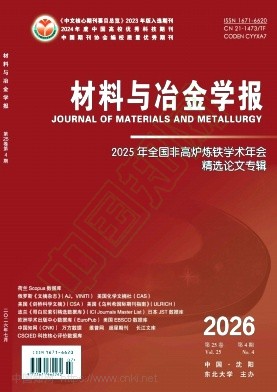
Development and industrial application of low-cost blast furnace ironmaking technologies
Gao Qiangjian;Lin Shijian;Cai Haoyu;Hong Ze;Zhang Jinhua;Liu Jian;Li Haokun;Wu Chenglin;Huang Haifeng;Zhou Haoyu;Jiang Zhe;Against the backdrop of intensive cost reduction in steel enterprises, adjustments to raw material and fuel structures often lead to the disruption of blast furnace operational balance and fluctuations in furnace conditions, which have become key challenges restricting low-cost blast furnace ironmaking. To address these challenges, based on theoretical research and collaborative practices with several steel enterprises, the authors propose a low-cost intensified ironmaking technology scheme that takes both production stability and economic benefits into account. This paper systematically elaborates on the control strategy for low-cost intensified ironmaking from four aspects: increasing the proportion of low-cost raw materials and fuels, adjusting the slag system to match low-cost raw materials and fuels, implementing an oxygen-coal-coke coordinated intensified ironmaking strategy, and optimizing blast furnace operations to adapt to low-cost ironmaking conditions. The proposed scheme aims to minimize blast furnace fluctuations caused by the charging of low-cost raw materials and fuels, thereby providing an engineering reference for long-term stable and smooth blast furnace operation and effective cost reduction under low-cost raw material and fuel conditions. At present, this technology has been promoted and applied in more than ten steel enterprises in China, achieving favorable results in cost reduction and efficiency improvement.
Technological innovation of hydrogen metallurgy in shaft furnace with zero-reforming coke oven gas and electric arc furnace short process
Wang Xindong;Hao Liangyuan;To address the resource and cost constraints of the mainstream production route of natural gas reforming hydrogen in China, an innovative, localized pathway was proposed and implemented: hydrogen metallurgy in shaft furnace with zero-reforming coke oven gas and electric arc furnace(EAF) short process. This technology eliminates the external gas reforming, directly utilizing by-product coke oven gas as the reducing gas. It has achieved breakthroughs in key technologies including gas purification & conditioning, compatible pellet preparation, and intelligent regulation of furnace control, enabling stable production of high-quality direct reduced iron(DRI) with a metallization rate more than 94.7% and a carbon content 2.5%~3.0%. For DRI-EAF smelting, some synergistic technologies covering rapid melting, graded control of residual elements, and nitrogen reduction & quality improvement have been developed. Industrial demonstration results over the past three years show that this short process reduces CO2 emissions by over 50%, while the core hydrogen metallurgy unit reduces more than 70% compared with the traditional blast furnace(BF)-basic oxygen furnace(BOF) long process, with lower pollutant emission and favorable economic performance. It also reserves the interfaces for green hydrogenintegration, offering a practical, scalable low-carbon transformation solution for iron and steel industry in China.
Research and application of key technologies for direct reduction in pure hydrogen shaft furnace
Zhou Hemin;Hao Xiaodong;Shen Pengfei;Xu Hongjun;Wu Bingqiang;Tian Fangzhou;Bai Xiaoguang;Feng Cong;Pure hydrogen metallurgy technology features the advantages of a green production process and clean final products, playing a leading role in helping the iron and steel industry break free from fossil fuel dependence, promote integration with new energy sources, and achieve near-zero carbon emissions.Pure hydrogen shaft furnace is highly adaptable to raw materials, and their direct reduction process overturns traditional carbon-based metallurgical principles.The key technologies required for pure hydrogen shaft furnace reduction, such as high-temperature hydrogen heating, hydrogen permeation-resistant refractories, and high-temperature hydrogen attack-resistant materials, are more demanding compared to those used in hydrogen-enriched shaft furnaces. Through large-scale experimental verification of pure hydrogen reduction of Bayan Obo oxidized pellets using a pure hydrogen shaft furnace independently developed by CISRI, it has been demonstrated that direct reduction iron with a metallization rate of over 96% could be achieved stably, which proves the process adaptability and industrial production feasibility of pure hydrogen metallurgy.The experiment results show that the optimal process parameters for the pure hydrogen shaft furnace include a hydrogen heating temperature of 1 000~1 050 ℃, a pressure of 0.30~0.35 MPa, and a total vertical pressure difference of approximately 0.025 MPa. Furthermore, due to the low pressure loss within the furnace, it allows to operate at a lower pressure compared to other types of gas-based shaft furnaces.When producing H2-DRI products with a metallization rate of over 96%, the pure hydrogen shaft furnace has a hydrogen consumption of about 540 m3(1 t DRI). The compressive strength of DRI ranges from 675 to 860 N per specimen. Dust generation per unit of reduction iron produced is 0.84%, while the average dust content in the top gas is 2.33 g/m3. The pure hydrogen shaft furnace developed by CISRI excels in stable operation, intelligent control, hydrogen regulation, and operational safety, providing a comprehensive solution for industrial production using pure hydrogen shaft furnace reduction.
Understanding and prospect on powder process of non-blast furnace ironmaking technology
Zhang Fuming;HIsmelt melting reduction is a non-blast furnace ironmaking process based on a powder process. It eliminates the need for agglomeration and coking processes, as iron ore and coal powders are injected into the smelting reduction vessel(SRV). High-temperature hot metal is directly produced by a series of reduction reactions, and the slag can be easily separated from the hot metal. After years of technological research and industrial trials, the HIsmelt process has achieved stable industrial operation, and the key technical indicators has met or been close to the design targets. Favorable application results have been obtained in terms of production efficiency, fuel consumption, and equipment life. To further optimize and improve this process, future efforts should focus on increasing the pre-reduction degree of iron ore powders and the inlet temperature. Meanwhile, the heat, mass, and momentum transfer in the SRV need to be enhanced, and the efficiency of energy conversion and heat utilization need to be improved. Furthermore, a hydrogen-based fluidized bed process for full-powder pre-reduction can be developed, integrating carbon dioxide removal and off-gas recycling as well as hydrogen metallurgy. This will significantly increase the metallization rate of iron ore powders and further reduce the direct consumption of carbon-based fuels. In addition, real-time optimization and dynamic, precise control of process parameters can also be achieved through the application of intelligent technologies.
Research progress on coke deterioration behavior and quality evaluation system under blast furnace operating condition
Xiao Xuhang;Hong Ze;Gao Qiangjian;Wang Yong;Jiang Xin;Fang Lichun;Zheng Haiyan;Shen Fengman;With the evolution of blast furnace ironmaking towards low carbon and high efficiency, alkali metals corrosion, high oxygen enrichment and extreme high-temperature environment pose severe challenges to the skeletal support function of coke. It is difficult to accurately characterize the real deterioration behavior of coke by using the traditional evaluation system under complex operating conditions due to their limited simulation conditions. The deterioration mechanism of coke under the deep coupling of thermal energy, chemical and mechanical factors was systematically reviewed in this paper. The cyclic enrichment process of alkali metals in blast furnace was analyzed emphatically, and its deterioration effect on coke was clarified. The consumption of coke due to the gasification and dissolution of H_2O and CO2 in the hydrogen-rich and oxygen-rich blast furnace environment was discussed deeply. The effects of graphitization and liquid phase erosion on the strength of coke in the dripping zone at high temperature were analyzed. Based on above analysis, a multi-dimensional coke quality evaluation system was constructed, aiming to consider the deterioration mechanism under alkali metals catalysis such as K and Na, the atmosphere damage effect under high oxygen and hydrogen enrichment conditions, and the impact of high temperature environment on coke strength in the dripping zone. It provides solid theoretical support for coke quality management and stable operation of blast furnace under high-strength smelting conditions.








































Identification and treatment of academic misconduct
To protect the right of readers and authors as well as to maintain the quality and reputation of the journal, Journal of Materials and Metallurgy adopts CNKI academic misconduct detection system for automatic detection. The general storeroom of China academic literature network will be used for academic misconduct detection, including plagiarism, forgery, falsification, improper attribution, and multiple submissions.
1. Recognition of Academic Misconduct Papers
For the paper with a repetition rate higher than 20%, the submitted paper, together with the comparison paper, will be submitted to the reviewer to determine the nature and form of the duplicated part and to give handling recommendations.
2. Handling of Academic Misconduct Papers
1) In a prudent manner, authors will be punctually notified from the editorial departmental when the paper is ultimately recognized as academic misconduct. Explanations and defenses are allowed before handling decisions are made.
2) If the paper has been accepted but has not been officially published, the author will be notified, and the paper will be rejected and disqualified in the paper processing system.
3) If the paper has been officially published, the author of the paper will be notified in written form. The acceptance qualification will be disqualified, and the online version of each database will also be revoked. The journal reserves the right to seek compensation for any loss of reputation or other damage caused to the journal.
4) For authors with serious misconducts, their names and affiliations will be published in the journal at an appropriate time together with revocation notice. The author's affiliation and other scientific and technical journals in the field will be notified.
3. Handling of authors’ dissent
If the authors have dissents with the recognition and handling results, they can apply a written application for review to the editorial department of the journal within 10 working days from the date of receiving the notice. The Journal will not accept the application after the deadline. The editorial department will be responsible for inviting experts to review the paper and making final handling opinions. The authors will be notified the final review results within 30 working days.
The above measures will be effective from the date of promulgation and will be interpreted by the Editorial Board of the Journal of Materials and Metallurgy.
Appendix: Recognition Criteria of Academic Misconduct Papers
1) Reproduction of another person's work in its original or substantially original form;.
2) Change the type of others’ work and regard the results completed by others as the results completed by themselves; or do not change the type of results, but use the components protected by copyright in the results and change the specific manifestations of the results, as their own independent results.
3) Use the protected views of others to form the whole, core or main point of his own paper as the main part or substantive part of one’s own academic paper;
4) Fabrication or falsification of research results, survey data, experimental data or documentation;
5) Citing protected ideas, programs, materials, data, etc. of others without reference notes
6) Multiple submissions.
Editorial Department of Journal of Materials and Metallurgy
Tracking the information about your manuscript
Communicate with the editorial office
Query manuscript payment status Edit officeCollecting, editing, reviewing and other affairs offices
Managing manuscripts
Managing author information and external review Expert Information Expert officeOnline Review
Online Communication with the Editorial Department
News
Journal of Materials and Metallurgy Accepted for Inclusion in Scopus
Journal of Materials and Metallurgy has been officially indexed by EuroPub!
Great news: Journal of Materials and Metallurgy has been indexed in JST’s Bibliographic Database Since 2024
The good news! Journal of Materials and Metallurgy has been included again in the "Overview of Chinese Core Journals" by Peking University (2023 edition).
more..Links
Page Views
International database inclusion

